ANT ORGANISMAL BIOLOGY, ECOLOGY AND EVOLUTION
  • Home
    • Collaborators
    • Joining
  • Integrative Organismal Biology
    • Research >
      • Host, Symbiont, and Microbiome Biodiversity
      • Mechanisms of Host-Symbiont Specificity and Homeostasis
      • Ecological Impacts of Macroorganisms on Soils and Soil Biota
    • People
    • Publications
  • Insect Microbial and Molecular Ecology
    • Research >
      • Microbial Ecology
      • Intergenomic epistasis and range expansion
      • Ant Mating Systems
      • Conservation Genetics
    • People
    • Publications

Conservation Genetics

We also work on the imperiled Comanche Harvester Ant, Pogonomyrmex comanche. Harvester ants are known to be ecologically important seed consumers in dry to arid ecosystems worldwide, but also important movers of soil as they build deep large subterranean nests. Very little is known about this species, especially the factors that might be responsible for its population decline. We are currently using molecular markers to understand more about its mating biology and landscape ecology to model habitat suitability of this species. This work is supported by the Texas Army National Guard. 
Picture


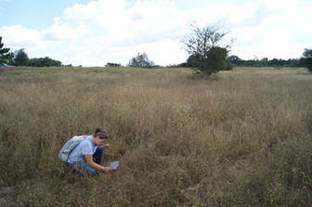
Graduate Student Rachel Romo collecting P. comanche at Camp Swift, Texas
​Seal, J., Matthews, A., McDanield, G., McFarland, E., & Kellner, K. (2024). Phylogeography of the imperiled Comanche Harvester Ant (Pogonomyrmex comanche). Insectes Sociaux. doi:10.1007/s00040-024-00981-4
  • Home
    • Collaborators
    • Joining
  • Integrative Organismal Biology
    • Research >
      • Host, Symbiont, and Microbiome Biodiversity
      • Mechanisms of Host-Symbiont Specificity and Homeostasis
      • Ecological Impacts of Macroorganisms on Soils and Soil Biota
    • People
    • Publications
  • Insect Microbial and Molecular Ecology
    • Research >
      • Microbial Ecology
      • Intergenomic epistasis and range expansion
      • Ant Mating Systems
      • Conservation Genetics
    • People
    • Publications